# creating surgical guide
**URL:** https://discourse.vtk.org/t/creating-surgical-guide/15581
**Category:** Support
**Tags:** code
**Created:** [May 7, 2025, 6:48pm UTC](https://discourse.vtk.org/t/creating-surgical-guide/15581 "2025-05-07T18:48:30Z")
**Posts on this page:** 3
**Page:** 1
### Author:  [@sreerajrs\_cdac](https://discourse.vtk.org/u/sreerajrs_cdac)
#### Post date: [May 7, 2025, 6:48pm UTC](https://discourse.vtk.org/t/creating-surgical-guide/15581/1 "2025-05-07T18:48:30Z")
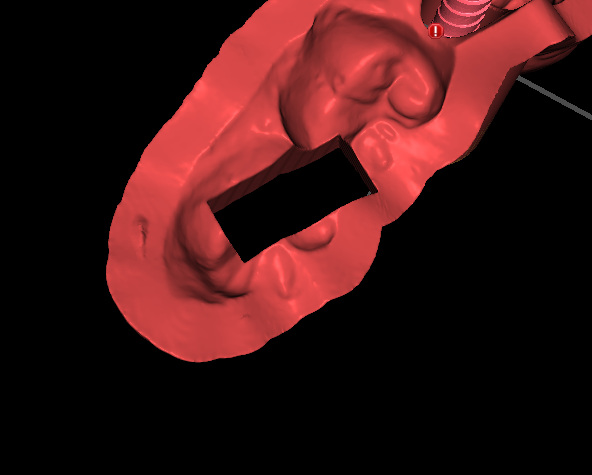
In the attached image, the **rectangular cropped area on the surface** is cleanly cut, and the **sidewall boundary is extruded in a different direction** , resulting in a **visible thickness** between the cropped surface and the sidewall. It looks like the sidewall is **extruded along a normal or tangential direction** , instead of simply following the direction of the rectangular crop.
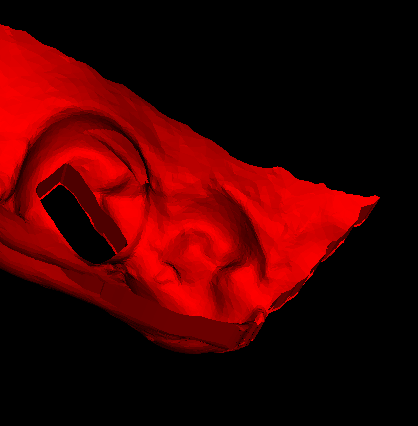
In my current surgical guide generation workflow, however, the **cropped surface and sidewall are aligned in the same direction** —there’s **no boundary wall thickness** , and the wall extends directly and perpendicularly from the cropped surface without any offset.
**How can I modify my extrusion logic to replicate the result shown in the image—where a single extrusion operation produces a sidewall that deviates from the crop direction and creates a boundary wall with thickness?** I’d prefer to achieve this in **a single extrusion step** , as using two separate extrusions creates two disconnected or overlapping layers.
Below one is the Surgical guide created by me!
---
### Author:  [@sreerajrs\_cdac](https://discourse.vtk.org/u/sreerajrs_cdac)
#### Post date: [May 8, 2025, 11:47am UTC](https://discourse.vtk.org/t/creating-surgical-guide/15581/2 "2025-05-08T11:47:00Z")
@lassoan @dgobbi @LucasGandel @mwestphal @ben.boeckel
---
### Author:  [@LucasGandel](https://discourse.vtk.org/u/LucasGandel)
#### Post date: [May 16, 2025, 2:34pm UTC](https://discourse.vtk.org/t/creating-surgical-guide/15581/3 "2025-05-16T14:34:05Z")
I’m not sure that I fully understood your question, but using [vtkWarpVector](https://examples.vtk.org/site/Cxx/PolyData/WarpSurface/) should give the “extrusion” along normals. You will have issues with self-intersection on teeth then, but implementing some kind of alpha wrap pass should help with that