# Dental models orientation
**URL:** https://discourse.vtk.org/t/dental-models-orientation/16311
**Category:** Support
**Tags:** code, proposal
**Created:** [March 3, 2026, 9:52am UTC](https://discourse.vtk.org/t/dental-models-orientation/16311 "2026-03-03T09:52:01Z")
**Posts on this page:** 5
**Page:** 1
### Author:  [@bassfaye](https://discourse.vtk.org/u/bassfaye)
#### Post date: [March 3, 2026, 9:52am UTC](https://discourse.vtk.org/t/dental-models-orientation/16311/1 "2026-03-03T09:52:02Z")
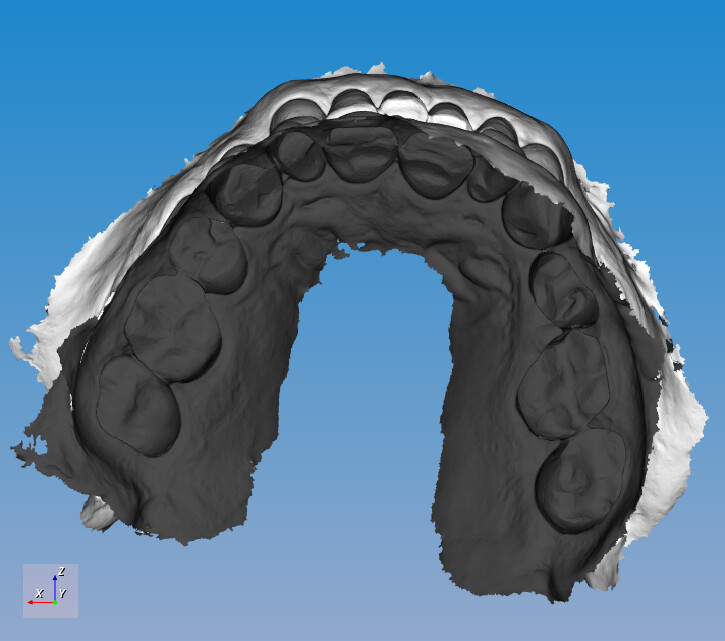
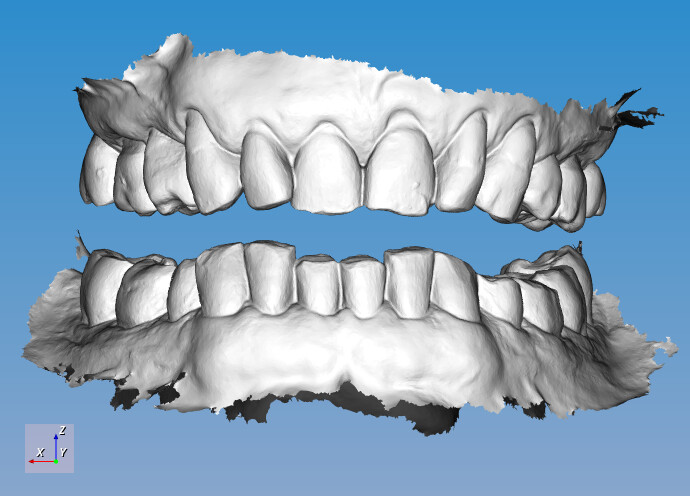
I have two dental models (upper and lower model). They are randomly oriented (see image 1). I want to orient dental models like image 2 (Y axis to anterior teeth face a consistent direction, Z axis to occlusal). How can I proceed to do that?
---
### Author:  [@mau\_igna\_06](https://discourse.vtk.org/u/mau_igna_06)
#### Post date: [March 3, 2026, 11:17pm UTC](https://discourse.vtk.org/t/dental-models-orientation/16311/2 "2026-03-03T23:17:23Z")
The no-code solution is to load the 3D models into 3D Slicer and use the interactive transform handles to do the rotation (or any other motion you want to achieve a realistic occlusal positioning between both models)
---
### Author:  [@bassfaye](https://discourse.vtk.org/u/bassfaye)
#### Post date: [March 4, 2026, 8:18am UTC](https://discourse.vtk.org/t/dental-models-orientation/16311/3 "2026-03-04T08:18:38Z")
Thanks for your reply. I use the no-code method to orient models one by one. However, I have a large number of models. I want a code solution in C++ to auto orient models to the dental standard orientation.
---
### Author:  [@Paulo\_Carvalho](https://discourse.vtk.org/u/Paulo_Carvalho)
#### Post date: [March 4, 2026, 2:06pm UTC](https://discourse.vtk.org/t/dental-models-orientation/16311/4 "2026-03-04T14:06:22Z")
Hello,
You can try using the ICP algorithm ([https://examples.vtk.org/site/Cxx/Filtering/IterativeClosestPointsTransform/](https://examples.vtk.org/site/Cxx/Filtering/IterativeClosestPointsTransform/)) to do a rigid (I suppose you don’t want the models to deform) registration against a reference model. The reference model could be the dental model shown in Fig. 2. ICP registration finds which rigid transform (only translation and rotation; no scaling, no shear) is needed so a model closely matches a reference model.
best,
PC
---
### Author:  [@Dakom](https://discourse.vtk.org/u/Dakom)
#### Post date: [March 4, 2026, 4:18pm UTC](https://discourse.vtk.org/t/dental-models-orientation/16311/5 "2026-03-04T16:18:05Z")
Hello,
In my experience, using directly the vtk ICP algorithm will only work if the models are almost already aligned. So I was thinking first use trimesh to do the “global registration”. Then vtk’s ICP should work. More detail on the global registration here :
> **[Global registration — Open3D latest (664eff5) documentation](https://www.open3d.org/docs/latest/tutorial/Advanced/global_registration.html)**
It’s something that I have to do with other objects. I didn’t fully test this method so there might be some problems along the way.