# How to find convex hull of a set of 3D points?
**URL:** https://discourse.vtk.org/t/how-to-find-convex-hull-of-a-set-of-3d-points/4591
**Category:** Support
**Created:** [November 6, 2020, 3:31am UTC](https://discourse.vtk.org/t/how-to-find-convex-hull-of-a-set-of-3d-points/4591 "2020-11-06T03:31:05Z")
**Posts on this page:** 6
**Page:** 1
### Author:  [@WangZP10969](https://discourse.vtk.org/u/WangZP10969)
#### Post date: [November 6, 2020, 3:31am UTC](https://discourse.vtk.org/t/how-to-find-convex-hull-of-a-set-of-3d-points/4591/1 "2020-11-06T03:31:05Z")
How to find the convex hull of a set of 3D points? I did not find a method in the VTK class. Similar functions are vtkHull and vtkPointsProjectedHull, but from the description it is not a way to obtain a set of 3D point convex hulls.
For 2D points, just use vtkConvex2D. For 3D points, maybe there is no vtkConvex3D method?
Thank you very much!
---
### Author:  [@lassoan](https://discourse.vtk.org/u/lassoan)
#### Post date: [November 6, 2020, 4:29pm UTC](https://discourse.vtk.org/t/how-to-find-convex-hull-of-a-set-of-3d-points/4591/2 "2020-11-06T16:29:50Z")
You can get convex hull of a 3D pointset using [vtkDelaunay3D](https://vtk.org/doc/nightly/html/classvtkDelaunay3D.html).
---
### Author:  [@Paulo\_Carvalho](https://discourse.vtk.org/u/Paulo_Carvalho)
#### Post date: [November 7, 2020, 9:46pm UTC](https://discourse.vtk.org/t/how-to-find-convex-hull-of-a-set-of-3d-points/4591/3 "2020-11-07T21:46:31Z")
Hello, Wang,
Complementing Andras’ answer, here’s an example with a full pipeline to extract the triangulated hull from the tetra tesselation generated by `vtkDelaunay3D`: [https://vtk.org/Wiki/VTK/Examples/Boneyard/Cxx/PolyData/ConvexHullDelaunay3D](https://vtk.org/Wiki/VTK/Examples/Boneyard/Cxx/PolyData/ConvexHullDelaunay3D)
cheers,
Paulo
---
### Author:  [@WangZP10969](https://discourse.vtk.org/u/WangZP10969)
#### Post date: [November 8, 2020, 12:51am UTC](https://discourse.vtk.org/t/how-to-find-convex-hull-of-a-set-of-3d-points/4591/4 "2020-11-08T00:51:29Z")
Thank you all, I will try the classes and examples you gave. The example website you gave is very useful. I did not find the example searched on [https://lorensen.github.io/VTKExamples/site/Cxx/](https://lorensen.github.io/VTKExamples/site/Cxx/). It may be because they have different categories.
Thanks again!
---
### Author:  [@WangZP10969](https://discourse.vtk.org/u/WangZP10969)
#### Post date: [November 9, 2020, 5:47am UTC](https://discourse.vtk.org/t/how-to-find-convex-hull-of-a-set-of-3d-points/4591/5 "2020-11-09T05:47:47Z")
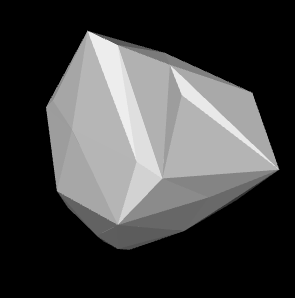 [output.vtp](https://discourse.vtk.org/uploads/short-url/3RL9K2YMOKVrQZqHEQXJ1CSFdqP.vtp) (2.4 KB) [points.vtp](https://discourse.vtk.org/uploads/short-url/7x7d1gAKw0xwerv0LyDmGuIk1e1.vtp) (3.5 KB)
Hello, Paulo
When I used this method, I found that the convex hull generated seemed inconsistent with the definition of convex hull I thought.
I used a point set generated from 100 random points to find the convex hull, but found that some of the triangular faces are concave. Is there a problem with my parameter settings?
cheers,
Wang
```auto
#include
#include
#include
#include
#include
#include
#include
#include
#include
#include
#include
#include
#include
#include
#include
int main(int, char* [])
{
//Create some random points
vtkSmartPointer points =
vtkSmartPointer< vtkPoints >::New();
for (int index = 0; index < 100; ++index)
{
points->InsertNextPoint(std::rand(), std::rand(), std::rand());
}
vtkSmartPointer< vtkPolyData> polydata =
vtkSmartPointer::New();
polydata->SetPoints(points);
vtkSmartPointer pointsWriter =
vtkSmartPointer::New();
pointsWriter->SetFileName("points.vtp");
pointsWriter->SetInputData(polydata);
pointsWriter->Write();
// Create the convex hull of the pointcloud
vtkSmartPointer delaunay =
vtkSmartPointer< vtkDelaunay3D >::New();
delaunay->SetInputData(polydata);
delaunay->Update();
vtkSmartPointer surfaceFilter =
vtkSmartPointer::New();
surfaceFilter->SetInputConnection(delaunay->GetOutputPort());
surfaceFilter->Update();
vtkSmartPointer ugWriter =
vtkSmartPointer::New();
ugWriter->SetInputConnection(delaunay->GetOutputPort());
ugWriter->SetFileName("delaunay.vtu");
ugWriter->Write();
vtkSmartPointer surfaceMapper = vtkSmartPointer::New();
surfaceMapper->SetInputConnection(surfaceFilter->GetOutputPort());
vtkSmartPointer surfaceActor = vtkSmartPointer::New();
surfaceActor->SetMapper(surfaceMapper);
vtkSmartPointer renderer =
vtkSmartPointer::New();
renderer->AddActor(surfaceActor);
vtkSmartPointer renderWindow =
vtkSmartPointer::New();
renderWindow->AddRenderer(renderer);
vtkSmartPointer renderWindowInteractor =
vtkSmartPointer::New();
renderWindowInteractor->SetRenderWindow(renderWindow);
vtkSmartPointer InteractorStyleTrackballCamera = vtkSmartPointer::New();
renderWindowInteractor->SetInteractorStyle(InteractorStyleTrackballCamera);
renderWindow->Render();
renderWindowInteractor->Start();
return EXIT_SUCCESS;
}
```
---
### Author:  [@Paulo\_Carvalho](https://discourse.vtk.org/u/Paulo_Carvalho)
#### Post date: [November 22, 2020, 1:14pm UTC](https://discourse.vtk.org/t/how-to-find-convex-hull-of-a-set-of-3d-points/4591/6 "2020-11-22T13:14:48Z")
Hello, Wang,
First, sorry for the late response.
By definition, a Delaunay tesselation’s outer boundary is convex, but we know theory is not always exactly the same as implementation. Take a look at the `vtkDelaunay3D`’s documentation: [https://vtk.org/doc/nightly/html/classvtkDelaunay3D.html:](https://vtk.org/doc/nightly/html/classvtkDelaunay3D.html:)
> The output of the Delaunay triangulation is supposedly a convex hull. **In certain cases this implementation may not generate the convex hull. This behavior can be controlled by the Offset instance variable.** Offset is a multiplier used to control the size of the initial triangulation. The larger the offset value, the more likely you will generate a convex hull; and the more likely you are to see numerical problems.
(emphasis added)
So I guess you need to play a bit with said parameter to get satisfactory results.
regards,
Paulo