# How to get the transformation values after applying vtkProcrustesAlignmentFilter
**URL:** https://discourse.vtk.org/t/how-to-get-the-transformation-values-after-applying-vtkprocrustesalignmentfilter/7776
**Category:** Support
**Created:** [February 4, 2022, 3:08pm UTC](https://discourse.vtk.org/t/how-to-get-the-transformation-values-after-applying-vtkprocrustesalignmentfilter/7776 "2022-02-04T15:08:32Z")
**Posts on this page:** 9
**Page:** 1
### Author:  [@dalbenzioG](https://discourse.vtk.org/u/dalbenzioG)
#### Post date: [February 4, 2022, 3:08pm UTC](https://discourse.vtk.org/t/how-to-get-the-transformation-values-after-applying-vtkprocrustesalignmentfilter/7776/1 "2022-02-04T15:08:32Z")
Hello,
I am using vtkProcrustesAlignmentFilter to align two polydata to their mutual mean. After applying this filter, is it possible to get the information of their transformation values -rotation and translation in particular?
Thank you in advance for any feedback you could provide 🙂
---
### Author:  [@lassoan](https://discourse.vtk.org/u/lassoan)
#### Post date: [February 6, 2022, 4:21am UTC](https://discourse.vtk.org/t/how-to-get-the-transformation-values-after-applying-vtkprocrustesalignmentfilter/7776/2 "2022-02-06T04:21:50Z")
If I remember well, vtkProcrustesAlignmentFilter is for groupwise analysis. You can use vtkLandmarkTransform or vtkIterativeClosestPointTransform to align two meshes.
---
### Author:  [@Paulo\_Carvalho](https://discourse.vtk.org/u/Paulo_Carvalho)
#### Post date: [February 6, 2022, 2:22pm UTC](https://discourse.vtk.org/t/how-to-get-the-transformation-values-after-applying-vtkprocrustesalignmentfilter/7776/3 "2022-02-06T14:22:21Z")
Hello, Gabriella,
Let:
- `A` an _n_ x 3 matrix composed by the _n_ known x,y,z coordinates of the original data set.
- `B` an _n_ x 3 composed by the _n_ known x,y,z coordinates of the data set in its final position.
First compute the center of gravities (c.g.) for both data sets by simply computing the mean of their x,y,z coordinates. Each c.g. is a single x,y,z tuple. The -x,-y,-z of them give you both translation matrices TA, and TB, which have this shape:
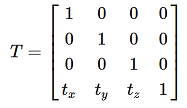
Now, bring both data sets to the origin (0,0,0) by subtracting the x,y,z’s of A and B by their respective c.g.‘s. The resulting data sets are A’ and B’. Now, let’s find the rotation matrix:
In 3D space your problem can be defined as this equation in matrix form: `A'X = B'`, where `X` is the unknown 3 x 3 transform matrix.
To find the unknown 3x3 transform, you need of course at least three points in your data set. Then, isolate `X`:
A’-1A’X = A’-1B’
X = A’-1B’
Transpose A’-1 so it becomes a 3 x _n_ matrix to be multipliable by the `B'` matrix.
Well, for real-world problems, `A'` won’t be square, so you can compute its pseudoinverse by using SVD (single value decomposition) to obtain three matrices:
svd(A’) = UΣV\*
The asterisk symbol denotes a conjugate transpose of the matrix. If your values are not complex, then it denotes only the transpose matrix.
The pseudoinverse of `A'`, termed A’†, can be found by doing:
A’† = VΣ†U\*, where:
- V is just the transpose of V\* if your x,y,z values are real-valued.
- U\* is, likewise, the transpose of U.
- Σ† is the pseudoinverse of Σ. This pseudoinverse can be found by:
a) replacing the non-zero values in its main diagonal by their reciprocals (1/x).
b) transposing the matrix with the reciprocals.
Then do X = A’†B’. Note that X is a matrix that may contain combined transforms. To find the rotation matrix, do an svd on X:
svd(X) = UΣV\*
The rotation matrix R is simply R = VU\*.
Computaionally, the Eigen library can be used to calculate these svd’s ([Eigen: SVD module](https://eigen.tuxfamily.org/dox/group __SVD__ Module.html)). Eigen is a header-only library so it’s easy to add to your project. The other matrix operations can be easily done with Eigen itself, VTK, Boost or one of the C++'s standard libraries.
I hope this helps,
Paulo
---
### Author:  [@Paulo\_Carvalho](https://discourse.vtk.org/u/Paulo_Carvalho)
#### Post date: [February 6, 2022, 2:25pm UTC](https://discourse.vtk.org/t/how-to-get-the-transformation-values-after-applying-vtkprocrustesalignmentfilter/7776/4 "2022-02-06T14:25:37Z")
Assuming the transform is rigid, that is: without shear, scaling and/or deformation, your final transform matrix is:
Y = TBRTA.
---
### Author:  [@Paulo\_Carvalho](https://discourse.vtk.org/u/Paulo_Carvalho)
#### Post date: [February 6, 2022, 2:37pm UTC](https://discourse.vtk.org/t/how-to-get-the-transformation-values-after-applying-vtkprocrustesalignmentfilter/7776/5 "2022-02-06T14:37:26Z")
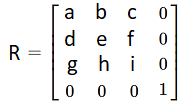
R is a 3x3 matrix. To become multiplication-compatible with the translation ones, just add a [0,0,0,1] column to the right of R and a [0,0,0,1] row to the bottom of R, so it has this shape:
---
### Author:  [@dalbenzioG](https://discourse.vtk.org/u/dalbenzioG)
#### Post date: [February 9, 2022, 2:31pm UTC](https://discourse.vtk.org/t/how-to-get-the-transformation-values-after-applying-vtkprocrustesalignmentfilter/7776/6 "2022-02-09T14:31:35Z")
Hi Paulo,
Thank you for spending your time explaining me exactly was I was looking for. I am working on implementing this solution in python. I will post it here once I am done.
🙏
---
### Author:  [@Paulo\_Carvalho](https://discourse.vtk.org/u/Paulo_Carvalho)
#### Post date: [February 9, 2022, 6:23pm UTC](https://discourse.vtk.org/t/how-to-get-the-transformation-values-after-applying-vtkprocrustesalignmentfilter/7776/7 "2022-02-09T18:23:35Z")
You’re quite welcome! This procedure may have mistakes in details such as signals or matrix dimensions. If you find them, please, be so kind as to report them here so we can correct them. Any peer reviews on this will be much appreciated!
---
### Author:  [@lassoan](https://discourse.vtk.org/u/lassoan)
#### Post date: [February 9, 2022, 6:41pm UTC](https://discourse.vtk.org/t/how-to-get-the-transformation-values-after-applying-vtkprocrustesalignmentfilter/7776/8 "2022-02-09T18:41:58Z")
@Paulo_Carvalho is the algorithm you described the Horn method? As I wrote above, that is available in vtkLandmarkTransform - ready to be used in both C++ and Python, for computing rigid, scaling, and affine transform and its inverse, directly from vtkPoints objects.
It is useful to understand the underlying basic algorithms and maybe even reimplementing them as a learning exercise, but for production use, most users will just want to use the existing robust, well-tested, optimized implementations in VTK registration classes.
---
### Author:  [@Paulo\_Carvalho](https://discourse.vtk.org/u/Paulo_Carvalho)
#### Post date: [February 9, 2022, 10:04pm UTC](https://discourse.vtk.org/t/how-to-get-the-transformation-values-after-applying-vtkprocrustesalignmentfilter/7776/9 "2022-02-09T22:04:28Z")
I think the OP wanted the separate components of the transform. As far as I know, `vtkLandmarkTransform` yields the final transform matrix. So, one still has to use SVD or some other factorization method to get the individual matrices.