# Reading voxels from Structured Points
**URL:** https://discourse.vtk.org/t/reading-voxels-from-structured-points/5591
**Category:** Development
**Created:** [April 20, 2021, 9:19am UTC](https://discourse.vtk.org/t/reading-voxels-from-structured-points/5591 "2021-04-20T09:19:36Z")
**Posts on this page:** 4
**Page:** 1
### Author:  [@ABWassim](https://discourse.vtk.org/u/ABWassim)
#### Post date: [April 20, 2021, 9:19am UTC](https://discourse.vtk.org/t/reading-voxels-from-structured-points/5591/1 "2021-04-20T09:19:36Z")
Hello everyone,
I’ve been using Binvox which is a tool that voxelizes 3D models and outputs the result in a Binary Structured Points VTK file. I wanted to some treatments on the voxels, so I used the vtkStructuredPointsReader and the vtkStructuredPoints classes. But when I parse the file, it tells me that I have 250047 voxels instead of the 4475 that I’m supposed to have. So basically, I have a huge 64x64x64 (which is the ‘DIMENSIONS’ is the header) cube made of voxels instead of the voxelized 3D model.
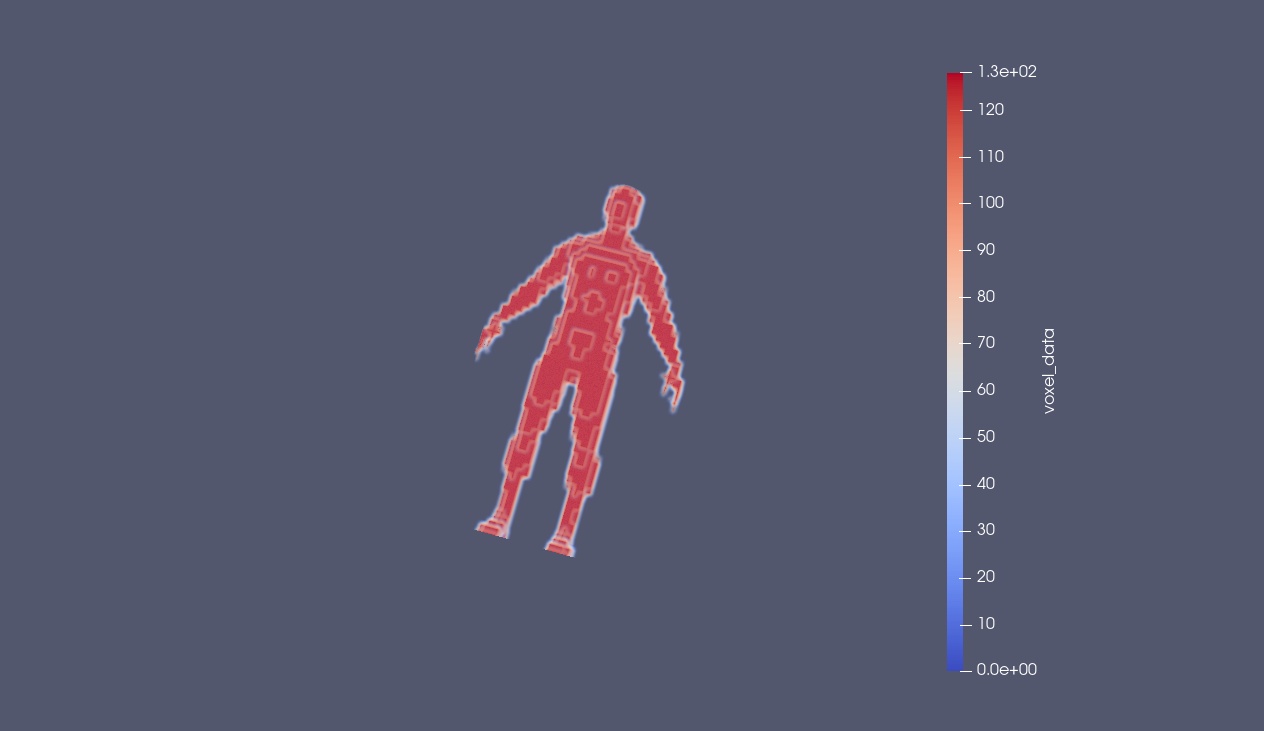
I feel like it has something to do with the SCALARS defined in the header because when i visualize the model on Paraview, every voxel of the 3D model is colored with the ‘voxel\_data’ value.
So my question is, how do I only get the voxels of the 3D model instead of every voxel inside the 64x64x64 box ?
Here is my code :
vtkNew reader;
reader-\>SetFileName(“FinalBaseMesh.vtk”);
reader-\>Update();
vtkStructuredPoints\* structuredPoints = reader-\>GetOutput();
cout \<\< structuredPoints-\>GetNumberOfPoints() \<\< endl; //262144
cout \<\< structuredPoints-\>GetNumberOfCells() \<\< endl; //250047
Here is the header of the VTK file (I can’t upload it) :
# vtk DataFile Version 3.0
#generated by [binvox], [http://www.google.com/search?q=binvox](http://www.google.com/search?q=binvox)
BINARY
DATASET STRUCTURED\_POINTS
DIMENSIONS 64 64 64
ORIGIN 0 0 0
SPACING 1 1 1
POINT\_DATA 262144
SCALARS voxel\_data unsigned\_char
LOOKUP\_TABLE default
The body is only spaces and ‘#’.
Thank you for your time,
Wassim.
---
### Author:  [@dgobbi](https://discourse.vtk.org/u/dgobbi)
#### Post date: [April 20, 2021, 3:17pm UTC](https://discourse.vtk.org/t/reading-voxels-from-structured-points/5591/2 "2021-04-20T15:17:28Z")
The definition of vtkStructuredPoints is a full rectangular grid of points, so it always provides all the voxels. In the master branch, there have recently been changes that allow a mask to be included with the voxels, but that’s still not a geometrical model in the conventional sense.
The vtkDiscreteMarchingCubes filter can create a boxy geometrical model from vtkStructuredPoints, it might be the best approach.
---
### Author:  [@will.schroeder](https://discourse.vtk.org/u/will.schroeder)
#### Post date: [April 20, 2021, 3:21pm UTC](https://discourse.vtk.org/t/reading-voxels-from-structured-points/5591/3 "2021-04-20T15:21:31Z")
Also consider vtkDiscreteFlyingEdges3D which is faster
---
### Author:  [@ABWassim](https://discourse.vtk.org/u/ABWassim)
#### Post date: [April 21, 2021, 9:12am UTC](https://discourse.vtk.org/t/reading-voxels-from-structured-points/5591/4 "2021-04-21T09:12:52Z")
Ok, thank you for your answers !