# Speedup iterative closest point using line search
**URL:** https://discourse.vtk.org/t/speedup-iterative-closest-point-using-line-search/11611
**Category:** Development
**Tags:** code
**Created:** [June 5, 2023, 12:54pm UTC](https://discourse.vtk.org/t/speedup-iterative-closest-point-using-line-search/11611 "2023-06-05T12:54:05Z")
**Posts on this page:** 10
**Page:** 1
### Author:  [@Jens\_Munk\_Hansen](https://discourse.vtk.org/u/Jens_Munk_Hansen)
#### Post date: [June 5, 2023, 12:54pm UTC](https://discourse.vtk.org/t/speedup-iterative-closest-point-using-line-search/11611/1 "2023-06-05T12:54:05Z")
I am considering parallelizing the heavy part of finding the closest point and introducing line-search to speed-up `vtkIterativeClosestPointTransform`. Has this been done before - or any thoughts on this?
---
### Author:  [@will.schroeder](https://discourse.vtk.org/u/will.schroeder)
#### Post date: [June 5, 2023, 1:42pm UTC](https://discourse.vtk.org/t/speedup-iterative-closest-point-using-line-search/11611/2 "2023-06-05T13:42:22Z")
“…parallelizing the heavy part of finding the closest point and introducing line-search to speed-up…” Can you provide references, more details to describe the approach?
---
### Author:  [@Jens\_Munk\_Hansen](https://discourse.vtk.org/u/Jens_Munk_Hansen)
#### Post date: [June 5, 2023, 3:43pm UTC](https://discourse.vtk.org/t/speedup-iterative-closest-point-using-line-search/11611/3 "2023-06-05T15:43:03Z")
I am working on it right now - just the parallization. I will see if I can find some good (non-propriarity) references and provide the details about speeding up the algorithm. Another thing that I am also looking into is to possibility to provide a noise dustribution. During the week I will find some good references.
---
### Author:  [@Jens\_Munk\_Hansen](https://discourse.vtk.org/u/Jens_Munk_Hansen)
#### Post date: [June 5, 2023, 4:07pm UTC](https://discourse.vtk.org/t/speedup-iterative-closest-point-using-line-search/11611/4 "2023-06-05T16:07:33Z")
Some time next week, I will make a small merge-request with a test for the current `vtkIterativeClosestPointTransform`, it is not covered by any tests. It will also help others who are used to work with a reference and a moving point cloud, rather than source and target. I primarily reached in case anybody had looked into this earlier or perhaps knew that another VTK-based open-source project had looked into this.
---
### Author:  [@lassoan](https://discourse.vtk.org/u/lassoan)
#### Post date: [June 5, 2023, 4:36pm UTC](https://discourse.vtk.org/t/speedup-iterative-closest-point-using-line-search/11611/5 "2023-06-05T16:36:44Z")
Our main problem with iterative closest point is not its speed. It is already fast enough for relatively large meshes. Even if the algorithm was slow for some humongous meshes, you would not need to speed up ICP for that, instead you could decimate one mesh and/or randomly drop points from the other mesh, as you can compute rigid registration very accurately from just a few thousand points.
**If there is time to VTK’s ICP implementation then please don’t spend it on making the current very simple algorithm _faster_ but make it _more robust_.**
Basic ICP method usually does not converge on real data because it would require very accurate initialization. This initialization is not trivial if the data is noisy or we are trying to register partial meshes (e.g., because they were acquired from different viewpoints or different imaging modality). This could be fixed by using a better initialization method and/or more robust optimization technique.
I heard that mesh registration in [Open3D](https://github.com/isl-org/Open3D) and [CloudCompare](https://github.com/CloudCompare/CloudCompare) (see some usage notes [here](https://www.cloudcompare.org/doc/wiki/index.php?title=Alignment_and_Registration)) work quite well in practice. Therefore, we would not need to invent anything new, just make some already proven methods available in VTK.
---
### Author:  [@Jens\_Munk\_Hansen](https://discourse.vtk.org/u/Jens_Munk_Hansen)
#### Post date: [June 5, 2023, 4:46pm UTC](https://discourse.vtk.org/t/speedup-iterative-closest-point-using-line-search/11611/6 "2023-06-05T16:46:08Z")
Thanks @lassoan . I am working on solving a real-time SLAM problem. Building up a dental model in real-time using 2.5D images. For the initialization, I use a trajectory for prediction.
For robust-ness, I am using a distance threshold on the correspondences using either a fixed cutoff or some simple statistics. This could be added to the VTK ICP implementation. Also, I am looking into supporting a noise model, say that we know that the error on the positions is larger in one direction. To handle this, I am providing an orientation as FieldData, since this may differ from the orientation provided with the vtkPolyData. I will look into what CloudCompare does to get some idea.
I am down to using less than 10 iterations, but it is still roughly an order-of-magnitude to slow for my real-time purposes.
After studying things a bit more, some general ideas may lead to general improvements for the VTK ICP implementation.
Thanks for reaching out
Jens
---
### Author:  [@lassoan](https://discourse.vtk.org/u/lassoan)
#### Post date: [June 5, 2023, 6:43pm UTC](https://discourse.vtk.org/t/speedup-iterative-closest-point-using-line-search/11611/7 "2023-06-05T18:43:05Z")
> [@Jens\_Munk\_Hansen](#):
>
> I am working on solving a real-time SLAM problem
I see, for real-time applications indeed the current ICP might not be fast enough, especially if you use the full-resolution scan for registration.
Looking forward to seeing your distance threshold based outlier rejection or more sophisticated methods from Open3D etc. in VTK!
---
### Author:  [@Jens\_Munk\_Hansen](https://discourse.vtk.org/u/Jens_Munk_Hansen)
#### Post date: [June 5, 2023, 6:49pm UTC](https://discourse.vtk.org/t/speedup-iterative-closest-point-using-line-search/11611/8 "2023-06-05T18:49:38Z")
> [@lassoan](#):
>
> I see, for real-time applications indeed the current ICP might not be fast enough, especially if you use the full-resolution scan for registration.
I limit the number of points and use around 500 landmarks. I have had a lot of success with sorting the signed distances and removing e.g. a quantile for both negative and positive. Alternatively, I could truncate using +/- one standard deviation. I like this better than a fixed cutoff like done in `VMTK`.
---
### Author:  [@Jens\_Munk\_Hansen](https://discourse.vtk.org/u/Jens_Munk_Hansen)
#### Post date: [June 29, 2023, 3:35pm UTC](https://discourse.vtk.org/t/speedup-iterative-closest-point-using-line-search/11611/9 "2023-06-29T15:35:31Z")
I will see if I can find some good references. I am currently working an ICP which can be used for meshes. The optimization is done using a Levenberg Marquardt and the cost function supports an either fixed metric (expected noise depend on an orientation) or where the error term depend on the local metric, e.g. the noise metric uses the local surface normals. It will only work for polydata if normals are used. The only little tweak is that for polydata you cannot set an orientation like you can now do for vtkImageData. Before submitting anything, I will find a good paper describing the approach - it must possible to find that.
---
### Author:  [@Jens\_Munk\_Hansen](https://discourse.vtk.org/u/Jens_Munk_Hansen)
#### Post date: [October 11, 2023, 9:48pm UTC](https://discourse.vtk.org/t/speedup-iterative-closest-point-using-line-search/11611/10 "2023-10-11T21:48:14Z")
Hi @will.schroeder
Sorry for bringing this up again.
I have made the classes below for registrations of `vtkPolyData`. Using a point-to-plane metric (easy addition) makes the convergence about 10 times faster. Also, it is important to have a `MaxDistance` to threshold the correspondences found.
I am using `vtkSMPTools` for parallelizing the closest points found using `vtkImplicitPolyDataDistance`, I will off course need to use the dispatcher and change the array to `vtkDataArray`.
Next step is to solve the problem using Gauss-Newton. Right now, correspondences are found in VTK and the registration is made using `Eigen`.
It is a work-in-progress.
Article with the algorithms: [https://www.robots.ox.ac.uk/~vgg/publications/2001/Fitzgibbon01c/fitzgibbon01c.pdf](https://www.robots.ox.ac.uk/~vgg/publications/2001/Fitzgibbon01c/fitzgibbon01c.pdf)
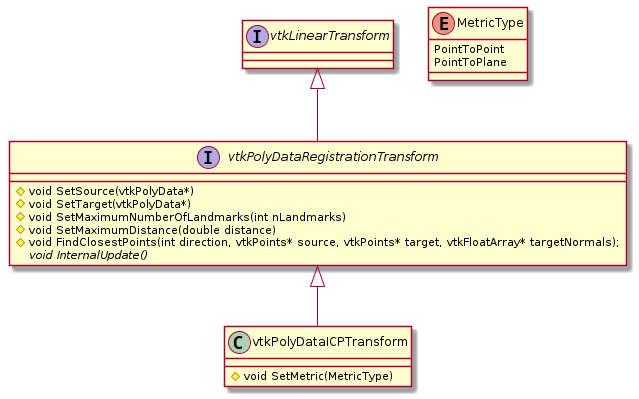
In order for this to fix into VTK, I would probably need to use PCA for for finding normals in case either source or target has no normals.
The reason for the interface `vtkPolyDataRegistrationTransform` is because I am working with multiple registration algorithms and all of them need correspondences and it is convenient to have the calculations of those in a base class.
An alternative would be to introduce a filter with two inputs, a method for setting the current transform and this should output two point clouds with normals if it is configured for this. We could call this `vtkPolyDataCorrespondenceFilter`.
What are you thoughts
I have started a small open-source project demonstrating the idea, where also the point-to-plane registration is implemented.
> **[GitHub - JensMunkHansen/IterativeClosestPoint: VTK Remote module for...](https://github.com/JensMunkHansen/IterativeClosestPoint)**
>
> VTK Remote module for registration using iterative closest point - GitHub - JensMunkHansen/IterativeClosestPoint: VTK Remote module for registration using iterative closest point