# Thickness or Depth of a polydata along a direction
**URL:** https://discourse.vtk.org/t/thickness-or-depth-of-a-polydata-along-a-direction/5076
**Category:** Support
**Created:** [January 28, 2021, 7:37am UTC](https://discourse.vtk.org/t/thickness-or-depth-of-a-polydata-along-a-direction/5076 "2021-01-28T07:37:58Z")
**Posts on this page:** 7
**Page:** 1
### Author:  [@DFlyer](https://discourse.vtk.org/u/DFlyer)
#### Post date: [January 28, 2021, 7:37am UTC](https://discourse.vtk.org/t/thickness-or-depth-of-a-polydata-along-a-direction/5076/1 "2021-01-28T07:37:58Z")
Hello,
I am trying to scalar plot thickness ( or depth ) of a water tight polydata along a direction.
Currently I create a line from a point on polydata and perform vtkOBBTree -\> IntersectWithLine, get the distance between point and intersection point as my thickness ( depth value ). But it takes some considerable time when number of points increase, also the plot is not smooth for low poly count.
Is there a filter or a better method that provides this depth value faster and provide higher resolution?
Image for reference
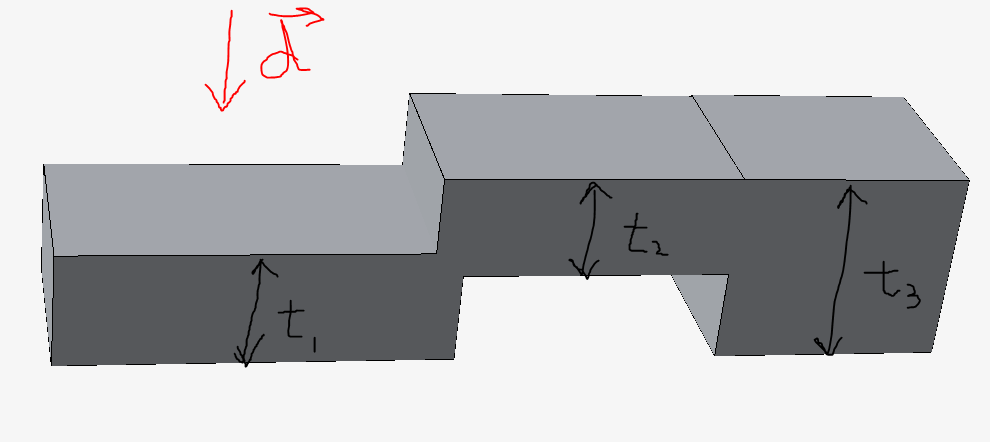
Thanks!
---
### Author:  [@lassoan](https://discourse.vtk.org/u/lassoan)
#### Post date: [January 28, 2021, 5:38pm UTC](https://discourse.vtk.org/t/thickness-or-depth-of-a-polydata-along-a-direction/5076/2 "2021-01-28T17:38:06Z")
If you use a good locator then this should be very fast, even for hundreds of thousands of points.
---
### Author:  [@DFlyer](https://discourse.vtk.org/u/DFlyer)
#### Post date: [January 28, 2021, 6:11pm UTC](https://discourse.vtk.org/t/thickness-or-depth-of-a-polydata-along-a-direction/5076/3 "2021-01-28T18:11:24Z")
Thanks for the reply,
Can you please suggest a locator?
---
### Author:  [@lassoan](https://discourse.vtk.org/u/lassoan)
#### Post date: [January 28, 2021, 6:32pm UTC](https://discourse.vtk.org/t/thickness-or-depth-of-a-polydata-along-a-direction/5076/4 "2021-01-28T18:32:17Z")
The new static locators should be faster.
Also, in case you are developing in Python: Iterating through each point of a mesh is not something that you want to do in Python, as a hot loop performing very simple operation over hundreds of thousands of items will be 1-2 magnitudes slower in Python than in C++. You may need to implement a filter for this in C++ VTK and wrap it to use from Python.
---
### Author:  [@DFlyer](https://discourse.vtk.org/u/DFlyer)
#### Post date: [January 28, 2021, 6:33pm UTC](https://discourse.vtk.org/t/thickness-or-depth-of-a-polydata-along-a-direction/5076/5 "2021-01-28T18:33:54Z")
Thanks again!
I came back to VTK after a while, can you please specify the new locator class name?
Can the locator give all the intersection points? ( if intersection is more than 1 )
---
### Author:  [@will.schroeder](https://discourse.vtk.org/u/will.schroeder)
#### Post date: [January 28, 2021, 7:05pm UTC](https://discourse.vtk.org/t/thickness-or-depth-of-a-polydata-along-a-direction/5076/6 "2021-01-28T19:05:54Z")
vtkStaticPointLocator
vtkStaticCellLocator
Faster to build, but cannot be modified once built.
vtkPointLocator
vtkCellLocator
Can support incremental insertion etc.
---
### Author:  [@DFlyer](https://discourse.vtk.org/u/DFlyer)
#### Post date: [January 29, 2021, 6:53am UTC](https://discourse.vtk.org/t/thickness-or-depth-of-a-polydata-along-a-direction/5076/7 "2021-01-29T06:53:36Z")
In terms of resolution improvement, can I create free points ( points that are not indexed on cells ) and set scalar value ( thickness ) to it and color map it?
Thanks