# vtkHDFWriter for temporal PDS Collection
**URL:** https://discourse.vtk.org/t/vtkhdfwriter-for-temporal-pds-collection/15774
**Category:** Support
**Created:** [June 30, 2025, 6:09am UTC](https://discourse.vtk.org/t/vtkhdfwriter-for-temporal-pds-collection/15774 "2025-06-30T06:09:59Z")
**Posts on this page:** 11
**Page:** 1
### Author:  [@citronella3alain](https://discourse.vtk.org/u/citronella3alain)
#### Post date: [June 30, 2025, 6:09am UTC](https://discourse.vtk.org/t/vtkhdfwriter-for-temporal-pds-collection/15774/1 "2025-06-30T06:09:59Z")
I’m trying to recreate [How to write time dependent data in VTKHDF files](https://www.kitware.com/how-to-write-time-dependent-data-in-vtkhdf-files/) using the vtkHDFWriter instead of direct h5py wrangling.
I’ve successfully done the following:
- write a non-temporal partitioned data set collection using the vtk hdf writer
- use the vtk hdf writer to write a sphere polydata that undergoes the same transformations as those used in the example (with one sphere rather than two)
But I’m having trouble writing a temporal partitioned dataset collection with two spheres, i.e., the pipeline given in this example:
Here’s what I currently have appended to the pipeline code, i.e., after `warp.Update()`:
```auto
# since vtkhdfwriter requires a data assembly when writing a partitioned dataset collection, create a helper function that creates this data assembly
def create_data_assembly():
assembly = vtkDataAssembly()
root = assembly.GetRootNode()
assembly.AddNode("Sphere0", root)
assembly.AddNode("Sphere1", root)
return assembly
# Update once to get PDC from pipeline
warp.Update()
pdc = warp.GetOutputDataObject(0)
pdc.SetDataAssembly(create_data_assembly())
writer = vtkHDFWriter()
writer.SetInputConnection(warp.GetOutputPort())
writer.SetFileName(str(path))
writer.SetWriteAllTimeSteps(True)
writer.Write()
```
But I currently get this error:
`Temporal polydata initialization failed for PolyData transient.vtkhdf`
Thoughts? Thanks!
---
### Author:  [@lgivord](https://discourse.vtk.org/u/lgivord)
#### Post date: [June 30, 2025, 9:13am UTC](https://discourse.vtk.org/t/vtkhdfwriter-for-temporal-pds-collection/15774/2 "2025-06-30T09:13:34Z")
Hello @citronella3alain,
Indeed we need an assembly, like that I don’t know what could be your issue. Before writing a temporal pdc, are you able to write a non temporal pdc ?
Additionally, if you can share your data and your script it would be helpful.
FYI @Louis_Gombert
---
### Author:  [@citronella3alain](https://discourse.vtk.org/u/citronella3alain)
#### Post date: [June 30, 2025, 11:51pm UTC](https://discourse.vtk.org/t/vtkhdfwriter-for-temporal-pds-collection/15774/3 "2025-06-30T23:51:18Z")
Hi @lgivord ,
Thanks for your response! Yes, I am able to write a non-temporal partitioned data set collection, as follows:
```auto
# this works
def write_vtk_hdf_nontransient(path: Path):
sphere = vtkSphereSource()
sphere.SetThetaResolution(20)
sphere.SetPhiResolution(20)
sphere.Update()
surf_polydata = sphere.GetOutput()
# Convert surface to unstructured grid (for demo)
tri_filter = vtkTriangleFilter()
tri_filter.SetInputData(surf_polydata)
tri_filter.Update()
volume_ugrid = vtkUnstructuredGrid()
volume_ugrid.ShallowCopy(tri_filter.GetOutput())
# Create a surface mesh (PolyData) as-is
surface = surf_polydata
# Create a vtkPartitionedDataSetCollection
pdc = vtkPartitionedDataSetCollection()
pdc.Initialize()
# Partition 0 = volume mesh
pdc.SetNumberOfPartitionedDataSets(2)
pdc.SetNumberOfPartitions(0, 1)
pdc.SetNumberOfPartitions(1, 1)
pdc.SetPartition(0, 0, volume_ugrid)
pdc.GetMetaData(0).Set(vtkDataObject.FIELD_NAME(), "Volume")
# Partition 1 = surface mesh
pdc.SetPartition(1, 0, surface)
pdc.GetMetaData(1).Set(vtkDataObject.FIELD_NAME(), "Surface")
assembly = vtkDataAssembly()
root = assembly.GetRootNode()
assembly.AddNode("Volume", root)
assembly.AddNode("Surface", root)
pdc.SetDataAssembly(assembly)
writer = vtkHDFWriter()
writer.SetFileName(str(path))
# Important: set input as the PDC
writer.SetInputDataObject(pdc)
writer.Write()
return pdc
```
As for the temporal dataset, I’m currently using the pipeline defined in [How to write time dependent data in VTKHDF files](https://www.kitware.com/how-to-write-time-dependent-data-in-vtkhdf-files/) because I want to replicate this except using vtkhdfwriter. Here’s the complete code that I currently have **(this code does not work properly, this is what I’m trying to fix)**:
```auto
# this does not work properly
from pathlib import Path
def write_transient_pds(path: Path | None):
sphere0 = vtkSphereSource()
sphere0.SetPhiResolution(30)
sphere0.SetThetaResolution(30)
sphere0.SetRadius(10)
sphere1 = vtkSphereSource()
sphere1.SetPhiResolution(30)
sphere1.SetThetaResolution(30)
sphere1.SetRadius(10)
sphere1.SetCenter(15, 15, 15)
# store the spheres in a single partitioned data set
groupDataSets = vtkGroupDataSetsFilter()
groupDataSets.AddInputConnection(sphere0.GetOutputPort())
groupDataSets.AddInputConnection(sphere1.GetOutputPort())
groupDataSets.SetOutputTypeToPartitionedDataSetCollection()
# generate time steps
timeSteps = vtkGenerateTimeSteps()
timeSteps.SetInputConnection(groupDataSets.GetOutputPort())
timeValues = np.linspace(0.0, 2*np.pi, 100, endpoint=False)
timeSteps.SetTimeStepValues(100, timeValues)
# generate fields
addFields = vtkSpatioTemporalHarmonicsAttribute()
harmonics = np.array([
[1.0, 1.0, 0.6283, 0.6283, 0.6283, 0.0],
[3.0, 1.0, 0.6283, 0.0, 0.0, 1.5708],
[2.0, 2.0, 0.0, 0.6283, 0.0, 3.1416],
[1.0, 3.0, 0.0, 0.0, 0.6283, 4.7124]
])
for iH in range(harmonics.shape[0]):
addFields.AddHarmonic(harmonics[iH, 0],
harmonics[iH, 1],
harmonics[iH, 2],
harmonics[iH, 3],
harmonics[iH, 4],
harmonics[iH, 5])
addFields.SetInputConnection(timeSteps.GetOutputPort())
# warp spheres
warp = vtkWarpScalar()
warp.SetInputConnection(addFields.GetOutputPort())
warp.SetInputArrayToProcess(0, 0, 0,
vtkDataObject.FIELD_ASSOCIATION_POINTS,
'SpatioTemporalHarmonics')
warp.Update()
"""
# pdsc = warp.GetOutputDataObject(0)
# assembly = vtkDataAssembly()
# root = assembly.GetRootNode()
# assembly.AddNode("sphere1", root)
# assembly.AddNode("sphere2", root)
# pdsc.SetDataAssembly(assembly)
"""
if path:
writer = vtkHDFWriter()
writer.SetFileName(str(path))
# Important: set input as the PDC
# writer.SetInputDataObject(pdsc)
writer.SetInputConnection(warp.GetOutputPort())
writer.SetWriteAllTimeSteps(True)
writer.Write()
# return pdsc
return warp
```
One change from the original blog post is that I changed the `vtkGroupDataSetsFilter` output to pdc rather than just partitioned data set. Another two observations:
- If I pass the warp object, the vtkhdf writer dies.
- If I extract the output data object from the warp object and persist that, then the persisted object isn’t temporal.
Also, for reference, I have a working example of a temporal polydata using vtkhdfwriter:
```auto
# this works
def write_simple_temporal_sphere(output_path: str):
# 1. Create a basic sphere
sphere = vtkSphereSource()
sphere.SetRadius(10)
sphere.SetThetaResolution(30)
sphere.SetPhiResolution(30)
# 2. Generate 2 time steps (e.g., t = 0 and pi)
time_gen = vtkGenerateTimeSteps()
time_gen.SetInputConnection(sphere.GetOutputPort())
time_gen.SetTimeStepValues(2, [0.0, np.pi])
# 3. Add time-varying field with one harmonic
harmonics = vtkSpatioTemporalHarmonicsAttribute()
harmonics.SetInputConnection(time_gen.GetOutputPort())
harmonics.AddHarmonic(1, 0, 0.5, 0.5, 0.5, 0.0) # magnitude, frequency, direction, phase
# 4. Warp the mesh using the harmonic field
warp = vtkWarpScalar()
warp.SetInputConnection(harmonics.GetOutputPort())
warp.SetInputArrayToProcess(0, 0, 0, vtkDataObject.FIELD_ASSOCIATION_POINTS, "SpatioTemporalHarmonics")
# 5. Write to .vtkhdf with all timesteps
writer = vtkHDFWriter()
writer.SetInputConnection(warp.GetOutputPort())
writer.SetFileName(output_path)
writer.SetWriteAllTimeSteps(True)
writer.Write()
```
So tl;dr: I’m able to write a temporal polydata and I’m able to write a nontemporal partitioned dataset collection, but I don’t know how to write a temporal partitioned dataset collection to vtkhdf. Let me know what additional info I can provide.
Thanks again!
---
### Author:  [@lgivord](https://discourse.vtk.org/u/lgivord)
#### Post date: [July 7, 2025, 7:27am UTC](https://discourse.vtk.org/t/vtkhdfwriter-for-temporal-pds-collection/15774/4 "2025-07-07T07:27:33Z")
Hi @citronella3alain,
I modify a bit your script to generate the assembly and it seems to work as expected with vtk 9.5.0 :
[test.py](https://discourse.vtk.org/uploads/short-url/pmfZTDTtES1CbfhfI1Xvr5Csmao.py) (3.4 KB)
let me know if it works on your side too.
here is what I have with ParaView master :
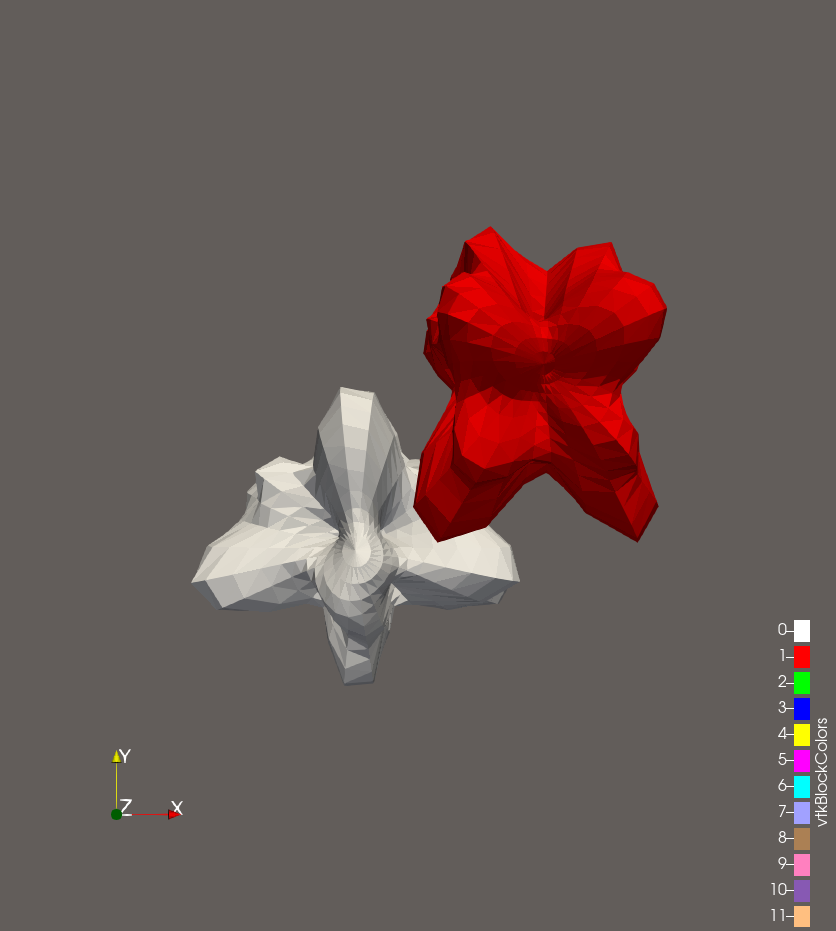
---
### Author:  [@citronella3alain](https://discourse.vtk.org/u/citronella3alain)
#### Post date: [July 9, 2025, 8:47pm UTC](https://discourse.vtk.org/t/vtkhdfwriter-for-temporal-pds-collection/15774/5 "2025-07-09T20:47:56Z")
@lgivord Thanks for taking a look.
While the partitioned data set does write, it isn’t temporal even though “write all timesteps” is enabled.
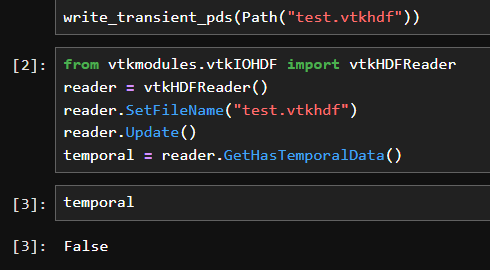
As a comparison, the temporal polydata I have above does the following:
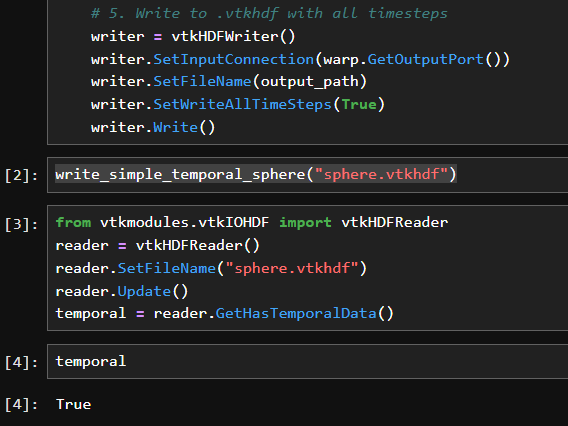
That said, I took a look at the temporal sphere in Paraview and I realized that while it has timesteps (unlike temporal pdsc), it only recorded the 0th one. So… I’m still confused how writing temporal data works.
I also found out that the vtkhdfreader doesn’t seem able to read the vtkhdf file created here: [How to write time dependent data in VTKHDF files](https://www.kitware.com/how-to-write-time-dependent-data-in-vtkhdf-files/). I get this error:
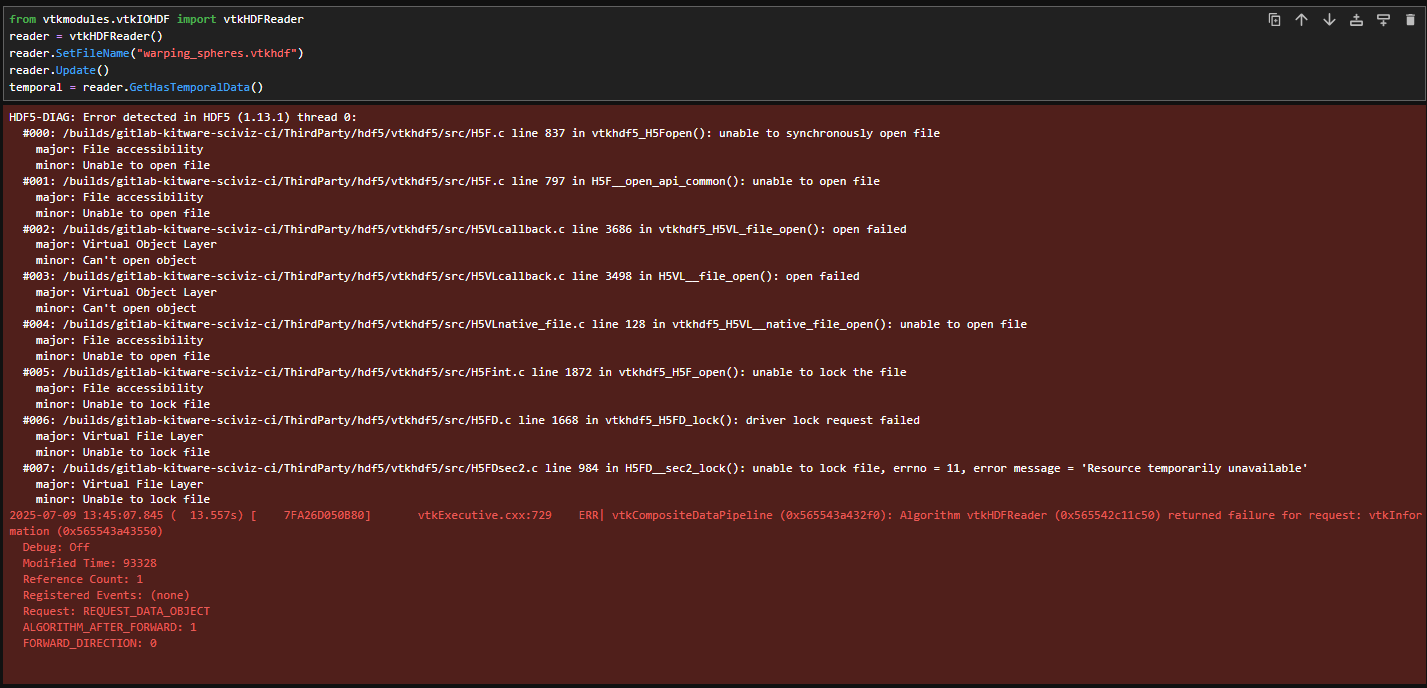
So yeah, I guess I’m generally confused how to use the vtk hdf writer to encode the different points across timesteps in a mesh.
---
### Author:  [@lgivord](https://discourse.vtk.org/u/lgivord)
#### Post date: [July 21, 2025, 6:37am UTC](https://discourse.vtk.org/t/vtkhdfwriter-for-temporal-pds-collection/15774/6 "2025-07-21T06:37:35Z")
@Louis_Gombert any idea ?
---
### Author:  [@Louis\_Gombert](https://discourse.vtk.org/u/Louis_Gombert)
#### Post date: [July 21, 2025, 6:50am UTC](https://discourse.vtk.org/t/vtkhdfwriter-for-temporal-pds-collection/15774/7 "2025-07-21T06:50:07Z")
“unable to lock the file” usually means that the file was not closed properly after writing or reading
---
### Author:  [@Louis\_Gombert](https://discourse.vtk.org/u/Louis_Gombert)
#### Post date: [July 21, 2025, 6:58am UTC](https://discourse.vtk.org/t/vtkhdfwriter-for-temporal-pds-collection/15774/8 "2025-07-21T06:58:09Z")
And the dataset is not temporal because we’re breaking the VTK pipeline by adding an assembly manually; `writer.SetInputData(pdc)` should be `writer.SetInputConnection(warp.GetOutputPort())`, so the execution pipeline is aware of time steps. Of course, this does not work, because warp does not have an assembly. This is why, for our testing, we created [a filter](https://gitlab.kitware.com/vtk/vtk/-/blob/master/IO/HDF/Testing/Cxx/HDFTestUtilities.h?ref_type=heads#L23) adding assembly to a PDC. [Until Group Datasets outputs an assembly](https://gitlab.kitware.com/vtk/vtk/-/issues/19650), the best option is to create the same filter in Python.
---
### Author:  [@citronella3alain](https://discourse.vtk.org/u/citronella3alain)
#### Post date: [July 23, 2025, 11:15pm UTC](https://discourse.vtk.org/t/vtkhdfwriter-for-temporal-pds-collection/15774/9 "2025-07-23T23:15:59Z")
OK thanks for the reply @Louis_Gombert @lgivord
- As for creating a Python filter, do you have an example? I followed [this tutorial](https://adamdjellouli.com/articles/vtk_examples/09_custom_filters_and_algorithms) but it doesn’t seem to work. I opened a new discourse thread for this: [Creating custom filter in Python - Support - VTK](https://discourse.vtk.org/t/creating-custom-filter-in-python/15854)
- In the meantime, I wanted to know what was wrong with my earlier example of writing a temporal polydata (sphere) to vtkhdf. Here’s the code:
```auto
def write_simple_temporal_sphere(output_path: str):
# 1. Create a basic sphere
sphere = vtkSphereSource()
sphere.SetRadius(10)
sphere.SetThetaResolution(30)
sphere.SetPhiResolution(30)
# 2. Generate 2 time steps (e.g., t = 0 and pi)
time_gen = vtkGenerateTimeSteps()
time_gen.SetInputConnection(sphere.GetOutputPort())
time_gen.SetTimeStepValues(2, [0.0, np.pi])
# 3. Add time-varying field with one harmonic
harmonics = vtkSpatioTemporalHarmonicsAttribute()
harmonics.SetInputConnection(time_gen.GetOutputPort())
harmonics.AddHarmonic(1, 0, 0.5, 0.5, 0.5, 0.0) # magnitude, frequency, direction, phase
# 4. Warp the mesh using the harmonic field
warp = vtkWarpScalar()
warp.SetInputConnection(harmonics.GetOutputPort())
warp.SetInputArrayToProcess(0, 0, 0, vtkDataObject.FIELD_ASSOCIATION_POINTS, "SpatioTemporalHarmonics")
# 5. Write to .vtkhdf with all timesteps
writer = vtkHDFWriter()
writer.SetInputConnection(warp.GetOutputPort())
writer.SetFileName(output_path)
writer.SetWriteAllTimeSteps(True)
writer.Write()
```
While reading the file will tell me that it is temporal and there are 2 timesteps, the points don’t seem to differ between the two timesteps. Is there something wrong with my pipeline?
Thanks!
---
### Author:  [@citronella3alain](https://discourse.vtk.org/u/citronella3alain)
#### Post date: [August 6, 2025, 10:28pm UTC](https://discourse.vtk.org/t/vtkhdfwriter-for-temporal-pds-collection/15774/10 "2025-08-06T22:28:10Z")
@Louis_Gombert
A propos custom filter, would it look something like this?
```python
from vtkmodules.util.vtkAlgorithm import VTKPythonAlgorithmBase
from vtkmodules.vtkCommonDataModel import vtkDataAssemblyUtilities
class vtkAddAssembly(VTKPythonAlgorithmBase):
def __init__ (self):
super(). __init__ (
nInputPorts=1,
nOutputPorts=1,
inputType='vtkPartitionedDataSetCollection',
outputType='vtkPartitionedDataSetCollection'
)
def RequestData(self, request, inInfo, outInfo):
input_obj = vtkPartitionedDataSetCollection.GetData(inInfo[0])
output_obj = vtkPartitionedDataSetCollection.GetData(outInfo)
output_obj.ShallowCopy(input_obj)
hierarchy = vtkDataAssembly()
vtkDataAssemblyUtilities.GenerateHierarchy(input_obj, hierarchy, output_obj)
return 1
```
and pipeline linkage like:
```python
...
# warp spheres
warp = vtkWarpScalar()
warp.SetInputConnection(addFields.GetOutputPort())
warp.SetInputArrayToProcess(0, 0, 0,
vtkDataObject.FIELD_ASSOCIATION_POINTS,
'SpatioTemporalHarmonics')
add_assembly = vtkAddAssembly()
add_assembly.SetInputConnection(warp.GetOutputPort())
writer = vtkHDFWriter()
writer.SetInputConnection(add_assembly.GetOutputPort())
writer.SetFileName(str(path))
writer.SetWriteAllTimeSteps(True)
writer.Write()
```
?
Something seems wrong because running this pipeline crashes Python.
---
### Author:  [@Louis\_Gombert](https://discourse.vtk.org/u/Louis_Gombert)
#### Post date: [August 7, 2025, 2:10pm UTC](https://discourse.vtk.org/t/vtkhdfwriter-for-temporal-pds-collection/15774/11 "2025-08-07T14:10:41Z")
@citronella3alain this script works for me with vtk==9.5.0:
```auto
from vtkmodules.util.vtkAlgorithm import VTKPythonAlgorithmBase
from vtkmodules.vtkCommonDataModel import vtkDataAssemblyUtilities, vtkPartitionedDataSetCollection, vtkDataAssembly
from vtkmodules.vtkFiltersSources import vtkSphereSource
from vtkmodules.vtkFiltersGeneral import vtkGroupDataSetsFilter
from vtkmodules.vtkIOHDF import vtkHDFWriter
class vtkAddAssembly(VTKPythonAlgorithmBase):
def __init__ (self):
super(). __init__ (
nInputPorts=1,
nOutputPorts=1,
inputType='vtkPartitionedDataSetCollection',
outputType='vtkPartitionedDataSetCollection'
)
def RequestData(self, request, inInfo, outInfo):
input_obj = vtkPartitionedDataSetCollection.GetData(inInfo[0])
output_obj = vtkPartitionedDataSetCollection.GetData(outInfo)
output_obj.ShallowCopy(input_obj)
hierarchy = vtkDataAssembly()
vtkDataAssemblyUtilities.GenerateHierarchy(input_obj, hierarchy, output_obj)
return 1
sphere = vtkSphereSource()
group = vtkGroupDataSetsFilter()
group.SetInputConnection(sphere.GetOutputPort())
add_assembly = vtkAddAssembly()
add_assembly.SetInputConnection(group.GetOutputPort())
writer = vtkHDFWriter()
writer.SetInputConnection(add_assembly.GetOutputPort())
writer.SetFileName("test.vtkhdf")
writer.SetWriteAllTimeSteps(True)
writer.Write()
```